Blog
Education finance data helps us understand how public schools are funded and how money is shared across districts and schools. Policymakers, researchers, advocates, and community members use this information to make decisions, look at trends, and learn more about school funding.
In this blog post, we:
- Describe the main sources of education finance data
- Explain how the data is collected and reviewed
- Talk about why national data often takes time to become available
- Show how the data supports decision-making at the district, state, and national levels
What Are Common Sources of Education Finance Data?
Education finance data is not collected just to check off a task on the to-do list. It plays an important role in shaping education funding policy and deciding how funding is distributed to districts and schools.
At the federal level, education finance data is used to help distribute some education funding. One important source of education finance data is the National Public Education Financial Survey (NPEFS). The NPEFS collects yearly information from states about public education revenue and spending.
The U.S. Department of Education uses NPEFS data in several ways. For example, the data helps determine how Title I funds are shared. Title I provides extra support to schools and students in communities with more low-income families. Billions of Title I dollars are distributed across 50 states and U.S. territories. So, even small data errors can have big effects on states and school districts.
Another important data source is the School District Finance Survey, or F‑33. This survey collects yearly financial information from school districts, including how much money they receive and how they spend it. The F‑33 includes information on local property tax revenue, classroom spending, and support services. District and state policymakers use F‑33 data to understand spending patterns and compare spending across districts. At the federal level, F‑33 data is also used in funding formulas.
Together, the NPEFS at the state level and the F‑33 at the district-level are two of the only consistent, nationwide data sources that show how public education is funded across the United States.
These data sources use common standards, so they allow us to make meaningful comparisons that would otherwise be very difficult or impossible.
- Policymakers can compare their state’s funding system with those of other states.
- Advocates can identify funding patterns, raise public awareness, and support policy changes.
- The public can learn how school funding works and how it differs across communities.
- Researchers can study funding and spending patterns and explore how they connect to student outcomes.
But before people can use this information, it must go through a detailed collection and review process.
How Is Education Finance Data Collected?
Education finance data do not come from one system. Instead, it is gathered from many sources. Then it is reviewed, organized, and shared in one place.
People at the district, state, and federal levels help collect and review the data to make sure it is accurate. The process usually includes these steps:
- Districts gather information about the money they receive and how they spend it.
- State agencies review the information to make sure it is complete and that it follows standard definitions.
- The U.S. Census Bureau checks for unusual numbers or unexpected changes.
- Independent reviewers and the U.S. Department of Education review the data. Then they ask states and districts to fix missing or unclear information.
See Exhibit 1 for more details about the data collection and review process.
Exhibit 1. Steps in Collecting Federal School Finance Data
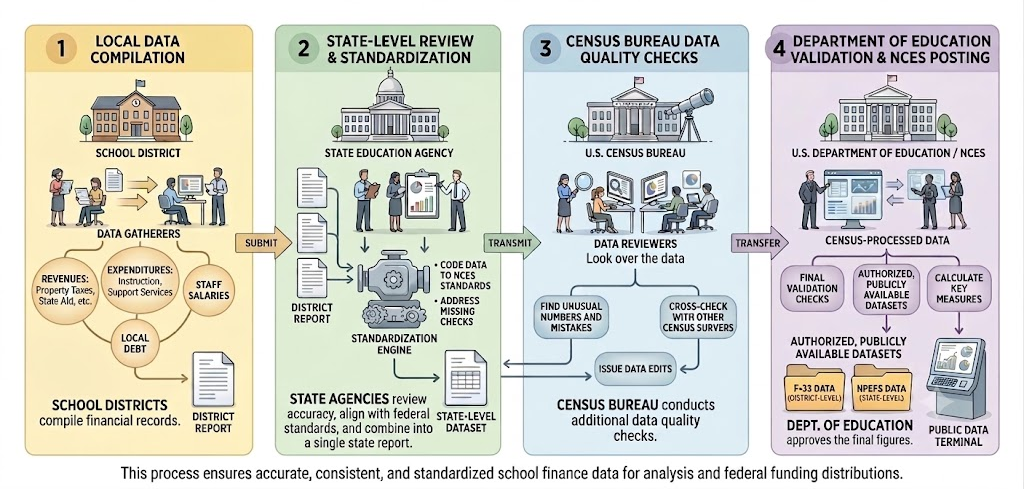
Image generated with assistance from Microsoft 365 Copilot. AIR staff reviewed and approved the content before posting.
From the outside, this process can seem slow. But each step has a purpose:
- Catch mistakes
- Fix differences in how data are reported
- Make sure everyone understands the numbers the same way
People can trust that the final data has been checked carefully before it is released. This careful review process helps explain why it takes time to release education finance data.
Why Isn’t Education Finance Data Available Right Away?
Education finance data is often released one or two years after a school year ends. This delay can be frustrating because people want the most current information in reports, dashboards, or tools like our Funding and Finance Data Map.
But the delay helps ensure the data is accurate and dependable.
The review process helps make sure the data is:
- Accurate: The data reflects what is happening in schools and districts.
- Consistent: The data is reported the same way across years, districts, and states.
- Comparable: The data is processed in similar ways across states so people can make fair comparisons.
These standards take time to meet, but they help ensure the data is reliable enough to support major education funding and finance decisions.
Why Does Comparability Matter?
One of the most important features of education finance data is that everyone uses the same definitions. (Check out our Strategic Funding and Finance-101 Glossary.)
Terms like current expenditures and instructional spending can mean different things in different states and districts. The data collection process makes sure districts and states use these terms the same way.
Using common terms lets us compare spending in meaningful ways. For example, we can compare spending per student, look at how funding is shared, and examine whether funding is keeping up with student needs. These comparisons help different groups use the data to answer important questions and make informed decisions.
How Is Education Finance Data Used?
Education finance data are collected in the same way across states and then carefully checked at all levels. So, leaders can use the data with confidence.
District leaders can compare spending patterns across similar districts; identify trends; and make decisions about budgets, staffing, and programs.
State leaders rely on education finance data to design and improve funding formulas. They also use the data to understand whether funding levels are meeting student needs.
Comparing the data across states also helps leaders understand how policy changes affect schools and districts.
Researchers and policy organizations analyze education finance data to understand how funding relates to student outcomes and educational opportunities. They also use the data to study funding systems and to create tools and visualizations.
Families, advocates, and the public can use information in our Funding and Finance Data Map and related resources to take part in conversations about school funding, including local ballot measures. Clear information about how education dollars are raised and spent helps build public trust and accountability.
Why Does Education Finance Data Matter?
Education finance data helps answer important questions about public education:
- How much money do we invest in education?
- Where does that money come from?
- How is it shared across schools and students?
The answers to these questions affect how districts and schools work and how they serve students and communities.
Good decisions depend on quality data. And quality data takes time to collect and review.
Even though education finance data may not be available right away, it plays an important role in shaping policy, supporting research, and increasing transparency. The review process takes time, but it helps ensure that the information is accurate and trustworthy before it is used to guide important funding decisions.
To learn more about how education finance data are collected, reviewed, and used, listen to our podcast with Stephen Cornman.