Blog
Most U.S. school districts use a single salary scale to pay their teachers. One benefit of this system is that it is easy to understand. One downside is that teacher pay does not work like pay in many other jobs that require a college degree. As a result, teachers make, on average, 24 percent less than workers in similar professions.
This blog explains why teacher pay is important. It also shares how states and districts are trying new approaches to paying teachers.
The $800 Billion Question
Each year, the United States spends more than $800 billion on K–12 education. More than half of that money––over 55 percent––goes to educator salaries and benefits. Teachers are the most important in-school factor in a child’s education. The way we pay them affects more than school budgets. It shapes schools’ ability to recruit, keep, and support the educators that students need.
To improve student achievement and provide all students with high-quality instruction, policymakers and education leaders need to understand how the labor market for teachers works. That means that they need to look at who becomes a teacher. They should also look at where teachers choose to work and whether they stay. Two of the biggest challenges are (1) recruitment; this refers to bringing qualified teachers into the profession or a specific school; and (2) retention; this refers to keeping effective teachers in the classroom.
Pay influences whether people enter teaching. It also affects where they choose to work and whether they stay. Challenges in recruitment and retention raise important questions about how we pay teachers. They also highlight how compensation systems might need to change.
The Single Salary Schedule as the Standard
For nearly 100 years, districts have used the single salary scale to pay educators. They use a “step and ladder” system. Under this system, districts raise a teacher’s pay by a “step” based on their experience. This is the number of years they have been a teacher. They move a teacher up the “ladder” based on their credentials, certifications, and responsibilities.
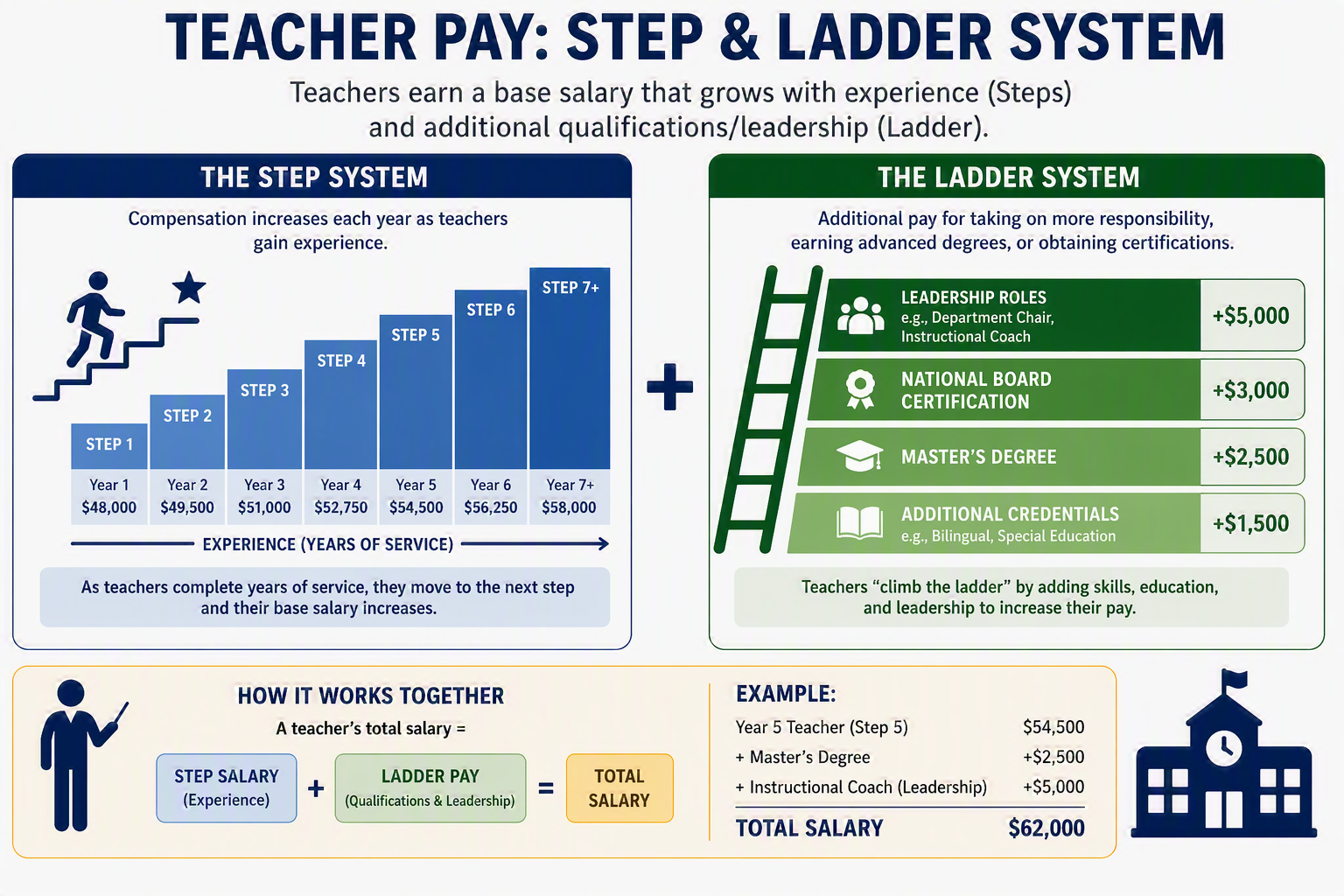
Image generated with assistance from Microsoft 365 Copilot. AIR staff reviewed and approved the content before posting.
The single salary scale addressed unfair compensation practices. In the early 20th century, school boards often paid men more than women. They also paid White teachers more than teachers of color. In contrast, the single salary scale made pay equal for teachers with the same credentials and years of experience.
Fair and transparent pay practices are still vital. But as districts work to recruit and keep strong teachers, many of them want to know whether pay systems should recognize the different roles, responsibilities, and contributions that teachers make across schools. Doing so could help districts to attract and keep teachers in the roles and schools where they are most needed.
Money Talks––for Teachers, Too
Pay matters in teaching just as it does in any other job. Teachers rely on their salaries to cover everyday expenses, support their families, and plan for the future.
It can be hard to recruit teachers when the single pay scale keeps wages lower than other early-career jobs for people with a college degree. Teachers may be more likely to leave when they don’t feel that their pay is fair based on the skills they bring, the credentials they earn, and the contributions they make to student learning.
Most of the pay scales for teachers save the biggest raises for later in their career. This is often after 15 or 20 years of teaching. That can make it hard for new teachers to stay. This is especially true when starting salaries may not cover student loans, housing costs, or other early-career expenses. It is not surprising that many teachers who leave the profession do so in their first five years.
Strategic Solutions
Researchers and policy experts have been looking at ways to make teaching more attractive. They also want to make it sustainable for decades to come. Two approaches are (1) targeted stipends and (2) performance-based pay.
Targeted Stipends
Some subjects, grades, and types of schools are harder to staff than others. This includes special education, rural areas, and schools in areas with high poverty. Targeted stipends offer higher salaries to the teachers who work in these areas. Hawaii offers a high-need subject stipend. It gives thousands of extra dollars each year to licensed special education teachers. Colorado provides targeted stipends of up to $6,000 to help recruit and support educators who work in rural areas. Research––including that for the Hawaii program––shows that these stipends can be one of the most cost-effective tools for filling high-need teaching jobs.
Performance-Based Pay
Performance-based pay gives a bonus or raise to teachers who show that they are improving student outcomes or getting high evaluation scores. The Dallas Independent School District has a Teacher Excellence Initiative (TEI). TEI ties pay to classroom performance. The state of Florida requires school districts to offer performance-based raises based on annual teacher reviews. The design of the performance-based pay system matters for success. Research has shown that it can support teacher recruitment and retention.
Teacher Pay as Workforce Strategy
Teacher pay is not just a budget issue. It is also a workforce strategy. As states and districts look at new approaches to pay, the goal should not be to abandon fairness or transparency. The goal should be to build on those principles in ways that better address today’s recruitment and retention challenges.
That means that we need to ask whether starting pay is competitive enough to attract new teachers. We should also ask whether pay structures encourage effective teachers to stay. Finally, we should ask whether we pay teachers for taking on roles that are hard to staff or for working in schools with the students who have the greatest needs.
There is no single answer for every state or district. But teacher pay systems should help schools to attract, retain, and support the educators that students need most. At the same time, these systems should be fair, transparent, and easy to understand.
For more information about teacher compensation, please check out our conversation with Dan Goldhaber. Dan is the Director of the Center for Analysis of Longitudinal Data in Education Research. You can also check out our chat with Mike Miles. Mike is the Superintendent of the Houston Independent School District. You can learn more about teacher starting salaries by state on our Funding and Finance Map.