Blog
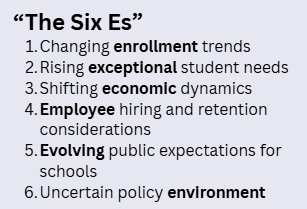
States and school districts face some big challenges when it comes to education finance. These pressures are deep, structural, and connected. At Afton Partners, we call these pressures “The Six Es.” They are (1) changing enrollment trends; (2) rising exceptional student needs; (3) shifting economic dynamics; (4) employee hiring and retention considerations; (5) evolving public expectations for schools; and (6) an uncertain policy environment. These factors shape the larger system, and drive the realignment we see now. They will affect education finance for years to come. Naming these pressures through the Six Es will help states and districts to be in a better position to address them in their budgets and in their long-term planning.
Changing trends in enrollment are making planning at the state and district levels a challenge. These trends will continue to have an impact in the long term. Enrollment is the biggest driver of education funding. Concern among state and district leaders about declines in enrollment has increased greatly in recent years. The National Center for Education Statistics predicts that enrollment in public elementary and secondary schools will decrease by 4% between 2020 and 2030. In contrast, enrollment went down by less than half of 1% in the 10 years from 2010 to 2020. This decline in enrollment is notable when looking at all states together, but it is also notable in the uneven patterns between states. The NCES predicts that only 12 states and the District of Columbia will have higher enrollment in 2030 than in 2020. NCES also predicts that 20 states will have declines greater than 5% over that same time frame.
Just as we expect overall enrollment to decline, we expect exceptional needs among students to rise. These needs include individual student needs, like services for English learners. They also include broader needs, like academic recovery efforts. Students with disabilities as a group grew by more than 17% from school year (SY) 2012–13 to SY 2022–23 (NCES). This is an all-time high. This group represents more than one out of every seven students. As enrollment declines and the pool of students with exceptional needs grows, the costs per pupil grow. And the wide range of services to support those needs also rises.
The overall dynamics in the economy have a big impact on state and district finances. These dynamics affect both expected revenue and required costs. As public entities, school districts are impacted by changes in the tax base. Districts compete for resources with other important state and local services. Alongside growing costs, districts feel the squeeze when it comes to maintaining their service baseline. School districts are staff-heavy operations by design. In fact, more than 79% of the expenditure costs for SY 2020–21 went to staff salaries and benefits (NCES). As such, districts will need to continue to invest in the hiring and retention of highly qualified employees. This is especially vital in positions that are hard to fill. The data on vacancies and certification make this need clear. These data show that, in 2025, schools either could not fill about one in eight teaching jobs across the country or they filled these jobs with teachers who are not yet fully certified. Shortages are most common in special education, math, and science.
At the local level, the changing role of schools has increased the expectations of the public when it comes to programs and student supports. This has led to a new baseline in the minds of the members of the community. Communities still expect that schools will serve the core academic and extracurricular functions. But schools have become central hubs for the delivery of other kinds of services and student support. In the past, communities viewed wraparound services and student supports as supplemental. These are services like mental health programs in schools and one-to-one device access. As communities think about the educational experience of students in pre-K through Grade 12, they now view these services as standard.
Each of these factors is playing out in an uncertain policy environment. There are broad political dynamics that are driving changes to the status quo. These dynamics have a big effect on states and districts as they plan for spending and implementation of programs. They also have a big effect on the roles that state and district leaders play in designing accountability systems. States and districts may turn to tools like scenario modeling and contingency planning. But due to the uncertain policy environment, strong partnerships between state and local education agencies are vital. These partnerships will help these agencies figure out what is in their control and how they can support success for all.
Keeping all of these factors in mind, it is clear that strong state and district partnerships are more important than ever. States need successful, stable districts; districts in turn need clear signals and funding that is sustainable from states. Each of the daily challenges faced by leaders at both levels are urgent. But the opportunity to align long-term structures, strategies, and spending is undeniable. The future of education finance solutions will come from those who treat today’s challenges as catalysts for smarter, more sustainable systems. Who will seize the moment created by these forces?