Blog
Educational leaders are expected to improve outcomes for students, advance equity, respond to emerging needs, and steward limited resources responsibly. To meet these expectations, leaders engage in strategic planning, continuous improvement, stakeholder engagement, and evidence-based decision-making. Yet one of the most powerful levers available to leaders is often viewed primarily as an administrative responsibility rather than a core leadership practice: resource allocation.
When leaders set ambitious goals, they inevitably face a series of resource decisions. Which initiatives should receive additional support? Which programs should be expanded, redesigned, or phased out? How should staffing, time, and funding be aligned to organizational priorities? And how can leaders know whether investments are producing meaningful results?
Answering these questions requires more than technical budgeting expertise. It requires leaders to connect organizational priorities, evidence, stakeholder perspectives, implementation efforts, and resource decisions in a coherent and continuous process. This is where strategic finance becomes essential.
Strategic finance is not simply about balancing budgets or managing expenditures. It is a leadership approach that helps organizations align resources with priorities, assess whether investments are creating value, engage stakeholders in difficult decisions, and continuously learn and adapt over time. When viewed through this lens, resource allocation becomes a mechanism for advancing strategy, supporting improvement, and achieving results for students.
In our work with state and local education leaders, we have found that strategic finance can be understood through five interconnected dimensions that help leaders create greater coherence between what they hope to accomplish and how resources are used to support those goals. These dimensions form the foundation of Strategic Finance Leadership.
Strategic Finance Is More Than Budgeting
Many education leaders hear the word finance and immediately think about budgets, accounting, and compliance requirements. While these functions are important, they represent only part of the picture.
Traditional views of school finance often emphasize technical budgeting functions. Strategic finance, however, can be understood more broadly as a leadership approach that helps organizations align resources with priorities and use evidence to determine whether investments are producing the results that matter most. Rather than focusing solely on how resources are spent, strategic finance focuses on how resources can be used to advance organizational goals, address student needs, and support continuous improvement.
Viewed through this lens, strategic finance is not separate from leadership. It is one of the primary ways leaders translate priorities into action, assess whether strategies are working, and make adjustments over time. Strategic finance provides the bridge between what organizations hope to achieve and how time, funding, staffing, and other resources are deployed to achieve those goals.
When practiced effectively, strategic finance helps leaders:
- Align resources with organizational priorities
- Connect investments to desired outcomes
- Create feedback loops between spending and results
- Support organizational learning and adaptation over time
In our work with state and local education leaders, we have found that these practices often show up in five interconnected dimensions. Together, they provide a framework for understanding how leaders can use strategic finance to align resources to results.
How Leaders Use Strategic Finance to Align Resources to Results
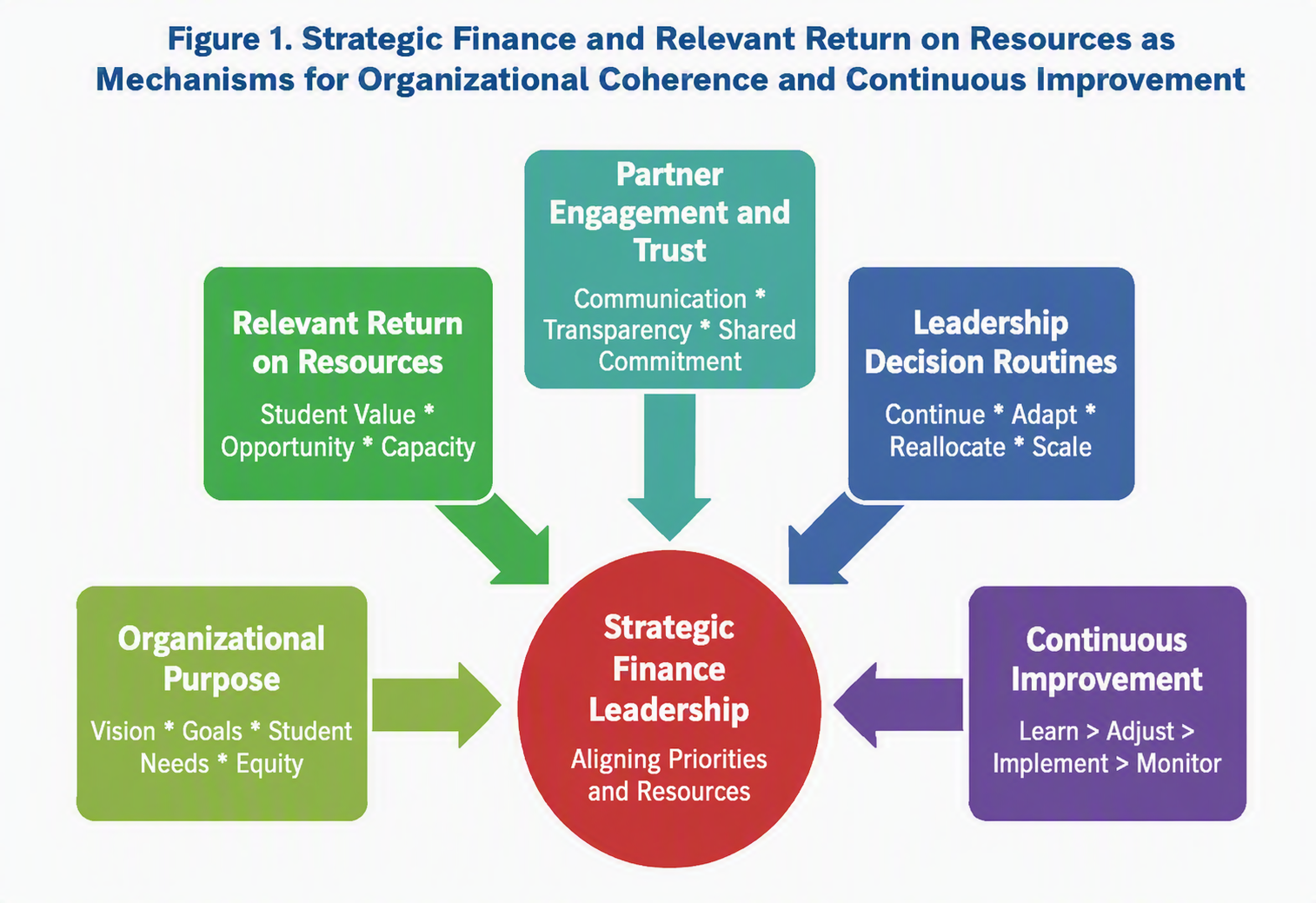
Strategic Finance Leadership places resource allocation within a broader system of organizational improvement. Rather than treating budgeting as a separate function, it recognizes that resource decisions are most effective when they are connected to organizational goals, evidence, stakeholder input, and continuous learning. As shown in Figure 1, five interrelated dimensions support this work.
1. Organizational Purpose
Strategic finance begins with a clear understanding of what an organization is trying to accomplish. Leaders use their vision, goals, student needs, and equity commitments to guide resource decisions and ensure that investments support the organization's most important priorities.
2. Relevant Return on Resources
Effective leaders routinely ask whether investments are generating meaningful value. That value may include:
- Student outcomes
- Student opportunities
- Organizational capacity
Relevant Return on Resources expands traditional notions of efficiency by considering whether resources are contributing to improved student outcomes, expanded opportunities, and stronger organizational capacity. These insights help inform decisions about whether investments should be continued, adapted, expanded, or reconsidered
3. Partner Engagement and Trust
Resource allocation decisions often involve difficult choices and tradeoffs. Strategic finance therefore depends on meaningful engagement with educators, families, students, community partners, and other stakeholders. Transparency and collaboration help build trust and strengthen collective ownership of improvement efforts.
Transparent communication and meaningful engagement with educators, families, and community members can build understanding and support for those decisions.
4. Leadership Decision Routines
Strategic finance becomes operational through the recurring practices leaders use to review evidence, evaluate investments, make resource decisions, and monitor progress. These routines help ensure that resource allocation remains intentional and responsive rather than being driven solely by annual budget cycles.
5. Continuous Improvement
Resource allocation should not be a once-a-year exercise. Strategic finance embeds resource decisions within ongoing cycles of learning, implementation, monitoring, reflection, and adjustment. This creates opportunities for organizations to learn from experience and continuously improve over time.
Together, these five dimensions provide a practical framework for leaders seeking to align resources with organizational priorities and improve outcomes for students. While each dimension is important on its own, the greatest value comes from how they work together. Organizational purpose shapes priorities, stakeholder engagement informs decisions, evidence helps assess results, and continuous improvement creates opportunities to learn and adapt over time.
The relationship among these dimensions becomes clearer when viewed through a real-world challenge. Consider how a district might apply Strategic Finance Leadership to address chronic absenteeism, an issue that affects student learning, engagement, and long-term success.
Strategic Finance in Action
Strategic finance is not a separate initiative, planning process, or budgeting exercise. It is a way of making leadership decisions about how resources can best support organizational goals and improve outcomes for students.
The five dimensions of Strategic Finance Leadership provide a framework for understanding how leaders can connect organizational priorities, resource allocation, stakeholder engagement, and continuous improvement. But strategic finance is most valuable when it informs day-to-day decisions about how resources are used to support students and achieve organizational goals.
Education leaders regularly face questions about where to invest limited resources, whether current investments are producing meaningful results, and how to adapt when circumstances change. These decisions rarely have simple answers. They require leaders to balance competing priorities, consider multiple sources of evidence, engage stakeholders, and make difficult tradeoffs. Strategic finance provides a structured approach for navigating these challenges.
Education leaders put strategic finance into practice in many different ways. Some conduct Resource Allocation Reviews to examine whether resources are aligned with priorities and student needs. Others use strategic finance professional learning, sustainability planning processes, strategic resource allocation indicators, or analyses of Relevant Return on Resources to inform decisions. While these approaches vary in purpose and design, they share a common goal: helping leaders connect priorities, resources, evidence, and improvement efforts in support of better outcomes for students.
The example below illustrates how the five dimensions can work together in practice. While focused on chronic absenteeism, the example reflects a broader leadership approach that can be applied to a wide range of improvement priorities, from literacy and academic recovery to workforce development and student well-being.
Example in Practice: Using Strategic Finance to Address Chronic Absenteeism
Consider a district that identifies chronic absenteeism as one of its most pressing challenges. Attendance data reveal that missed instructional time is affecting academic performance, student engagement, and overall well-being. The district's strategic plan calls for improving attendance, but district leaders are unsure whether existing resources are being used in ways that support that goal.
A traditional budgeting approach might focus on whether additional funding is available to launch a new attendance initiative. A strategic finance approach begins with a different question: How are our current resources contributing to our attendance goals, and how can we better align investments with those priorities?
Leaders start by examining attendance-related investments across the organization. They identify spending on family engagement programs, transportation supports, student mental health services, attendance personnel, community partnerships, and school climate initiatives. Rather than evaluating these efforts separately, they consider how they collectively contribute to the district's attendance goals.
The district then applies a Relevant Return on Resources lens. Leaders review available evidence and ask:
- Which investments appear to be improving attendance?
- Which student groups are benefiting most?
- Are there promising practices that could be expanded?
- Are there investments consuming resources without producing meaningful results?
This analysis reveals that schools with strong attendance improvements share several common strategies, including proactive outreach to families, targeted student supports, and partnerships with community organizations.
Next, district leaders engage principals, teachers, families, and community partners to better understand attendance barriers and discuss potential resource shifts. These conversations build trust and help stakeholders understand the rationale behind future decisions.
Using regular leadership decision routines, the district decides to reallocate some resources from lower-priority activities toward strategies that appear to be having a stronger impact on attendance. Leaders establish clear measures for monitoring progress and commit to reviewing outcomes throughout the year.
Importantly, the process does not end once resources are allocated. Attendance data, stakeholder feedback, and implementation evidence are reviewed regularly. Leaders use what they learn to refine strategies, make adjustments, and identify new opportunities for improvement.
In this example, strategic finance is not the budget document itself. It is the leadership process that connects organizational priorities, evidence, stakeholder engagement, resource decisions, and continuous improvement. By creating feedback loops between investments and outcomes, the district is better positioned to learn, adapt, and achieve its goals. This reflects the article's broader argument that strategic finance can serve as a mechanism for organizational coherence and continuous improvement.
While chronic absenteeism provides one example of how leaders can use strategic finance to align resources to results, the framework can be applied across a wide range of challenges. Whether leaders are seeking to improve student outcomes, sustain effective programs, strengthen organizational capacity, or navigate difficult resource decisions, strategic finance offers a structured approach for connecting priorities, investments, and evidence.
Additional Examples of Strategic Finance in Practice
Supporting Early Literacy Goals
A district identifies early literacy as a strategic priority and examines whether existing staffing, instructional materials, professional learning, and intervention resources are aligned with that goal. Leaders identify overlapping efforts, redirect resources to evidence-based practices, and monitor whether those investments improve literacy outcomes.
Sustaining High-Dosage Tutoring
A tutoring program funded through temporary grants shows positive results. Rather than automatically continuing or ending the program, leaders analyze its Relevant Return on Resources, examine sustainability options, and determine whether the initiative should be adapted, expanded, or incorporated into the district's long-term funding strategy.
Evaluating Professional Learning Investments
District leaders review professional learning expenditures to determine which activities are helping build educator capacity and advance organizational priorities. Evidence from implementation and outcomes informs decisions about which investments to continue, refine, scale, or discontinue.
Building Trust During Difficult Resource Decisions
A district faces declining enrollment and must make difficult staffing decisions. Rather than focusing solely on balancing expenditures with projected revenue, leaders engage educators, families, and community members in discussions about priorities, tradeoffs, and potential solutions. By grounding decisions in shared goals and student needs, leaders strengthen trust and build understanding even when stakeholders disagree with specific choices.
These examples demonstrate that strategic finance is not limited to annual budgeting. It is an ongoing leadership capability that helps organizations align priorities, investments, evidence, and improvement efforts over time. Regardless of the specific challenge, strategic finance helps leaders make intentional decisions about how resources can best support organizational goals and improve outcomes for students.
Across each of these examples, the central lesson is the same: resources matter most when they are intentionally aligned to purpose. Strategic finance helps leaders move beyond questions of how much is being spent and focus instead on whether investments are advancing organizational priorities and producing meaningful results.
From Budgeting to Leadership
Educational leaders increasingly recognize that sustainable improvement requires coherence across planning, evidence use, stakeholder engagement, and implementation. Strategic finance provides a mechanism for creating that coherence. When leaders view resource allocation as a leadership capability rather than a technical budgeting exercise, they are better positioned to align investments with priorities, learn from results, and continuously improve outcomes for students.
Educational leaders today face increasingly complex challenges and difficult resource decisions. Improving outcomes, advancing equity, responding to changing student needs, and sustaining effective programs all require more than sound budgeting practices. They require a deliberate approach to aligning resources with organizational priorities.
Strategic finance provides a framework for doing that work. By connecting organizational purpose, relevant return on resources, stakeholder engagement, leadership decision-making, and continuous improvement, strategic finance helps leaders create greater coherence between what they hope to accomplish and how resources are used to achieve those goals.
Ultimately, moving beyond budgeting is not about diminishing the importance of financial management. It is about recognizing that resource allocation is one of the most powerful leadership tools available to education leaders. When leaders approach resource decisions strategically, they are better positioned to align investments with priorities, learn from results, adapt over time, and improve outcomes for students.