Blog
Knowing what education programs really cost – not just what shows up in a budget – is key to making good funding decisions. For example, a new reading intervention may look affordable based on the advertised price, but the actual cost to implement includes teacher training, planning time, materials, and ongoing coaching. Every funding choice involves tradeoffs: money spent on expanding an after-school program might mean fewer dollars for transportation or family engagement, but those tradeoffs are hard to see (and quantify) without clear information about costs. When states and districts understand the actual cost of putting programs in place and keeping them going, they can make more informed decisions, better match resources to student needs and policy goals, and avoid relying on assumptions based only on budgets or spending totals.
Cost Analysis
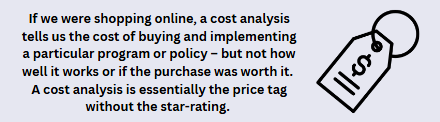
A cost analysis gives us information about how much a program or policy costs to implement – such as the per-student cost of a program aimed at increasing third grade literacy rates - by assigning a dollar value to all resources used in implementation. This cost can be represented as the per-student cost, a per-school cost, cost by program activity, or even a district-level cost (based on what makes the most sense).
A comprehensive cost analysis gives you important information about what resources are used in implementation – such as the number of teacher labor hours, the types and quantities of materials used, district staff time, etc. Both the cost and resource use information can help decision makers see whether a program can be supported with existing resources or if it requires new funding or shifted resources.
Cost-Effectiveness Analysis
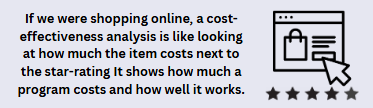
To know how much something costs AND how well it works, we need a cost-effectiveness analysis. Cost-effectiveness analysis combines cost information with evidence about a program’s impact to help leaders compare programs that aim for the same outcome. This helps us understand what resources we need to implement a program/policy and what we can likely expect to happen as a result.
A cost-effectiveness analysis requires a causal estimate of impact, meaning we use study design and statistical tools to make sure our estimated impact is a direct result of the policy or program of interest.
A cost-effectiveness analysis is also useful for comparing multiple programs that focus on the same outcome. For example, cost-effectiveness information about two different programs aimed at increasing third-grade literacy can help a decision maker select which is more effective and affordable based on available resources and goals.
Cost-Benefit Analysis
In a lot of cases, we have a set amount of education funding to address a bunch of issues: literacy, math skills, social-emotional skills, teacher retention, parent support, extra curriculars, etc. We often don’t have the luxury of comparing two or more programs aimed at the same outcome, and instead we have to decide which program(s) to implement across a variety of outcomes.
Other times, we may want to know if an investment in a specific policy/program results in greater benefits than the initial cost. For example, is an expensive high school dropout prevention program worth it based on the monetized benefits (outcomes converted into dollars) – such as higher earnings and lower unemployment – for students and the community?
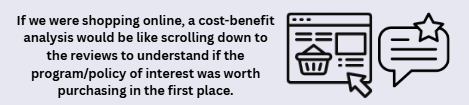
In these cases, a cost-benefit (or benefit-cost) analysis helps us compare multiple programs aimed at different outcomes and determine if the original investment to implement the programs was worth it based on the later monetized benefits.
Cost-benefit analyses are especially useful when deciding how to allocate limited funding because they can include a variety of outcomes that are linked to the original program or policy. So just like the online product reviews that list things you never realized might happen if you bought that product (like learning you can use the coffee pot to make Ramen!), cost-benefit analyses can highlight (and monetize) the outcomes that are associated with the program/policy of interest and compare those to the cost.
This table summarizes the different analysis types and how they can be used in decision making.
| Type of Analysis | Questions that can be answered | Potential shortcomings |
|---|---|---|
| Cost Analysis | What is the per-student cost of the program/policy? Can we afford to implement this program/policy? | Does not include information about estimated impact |
| Cost-effectiveness | What impact can we expect if we implement the program for this cost? What program gives us the biggest bang for our buck? | Does not include information about monetized benefits Cannot be used to compare programs that address different outcomes |
| Cost-benefit | Was the investment in this program/policy worth it? How do the monetized benefits compare to the original program cost in today’s dollars? | Can be hard to do in education because of the time horizon needed to estimate benefits. |
Why Looking at Your Budget Is Not Enough
It may seem like a budget or expenditure report is enough to show how much a program costs, but neither tells the full story.
Just like our own personal finances, a budget is a plan for spending, not a record of how much things actually cost. For example, we may spend more on one category of expenses, like food, than we planned, which then necessitates less spending in another category (e.g., concert tickets) – but a budget will not show that adjustment.
And just like our own personal finances, we don’t typically account for unexpected extra resource windfalls. Additional resources in our own finances might come in the form of a surprise grocery delivery from a generous relative (thank you, Uncle Marvin!), while additional resources in schools could come in the form of volunteered time from teachers or donated tablets from a local business. These things would not show up on a budget.
An expenditure report also misses essential information, such as donated/volunteered resources, which could lead to a cost underestimate.
To get the best cost estimates, it’s important to:
- Gather information about all the resources used in program/policy implementation (whether purchased, shared across programs, or donated)
- Identify accurate pricing (based on what exactly is needed for implementation)
- Estimate costs (cost = quantity x price)
This is the quick overview. For a more detailed exploration, AIR published the Standards for the Economic Evaluation of Educational and Social Programs in 2021, which highlights gold standards when producing cost, cost-effectiveness, and cost-benefit estimates. Although meeting all these standards is not always possible. Your understanding of how cost information can be useful and what’s needed to produce accurate cost estimates can help inform education funding and finance decisions.